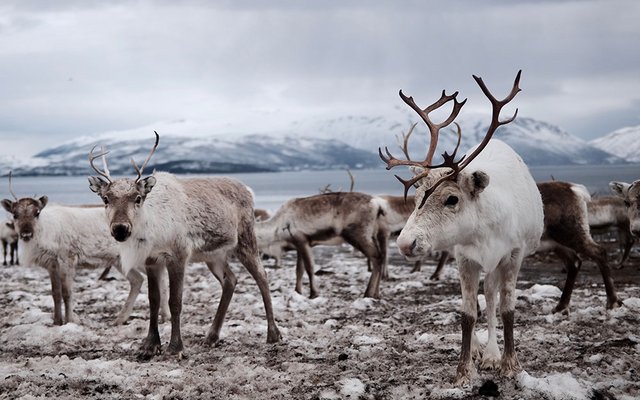
In the Arctic, reindeer are important because they can pull sleds.Foto: Valerio Febbo / Shutterstock.com


ENGLISH TO GO – Jänner 2026
Discover how people live in the Arctic Circle, where winters are dark and nature is extreme. Then travel back in time and explore the dramatic race to the North Pole.
Open the worksheet and listen to a radio show about ten facts from the Arctic Circle.
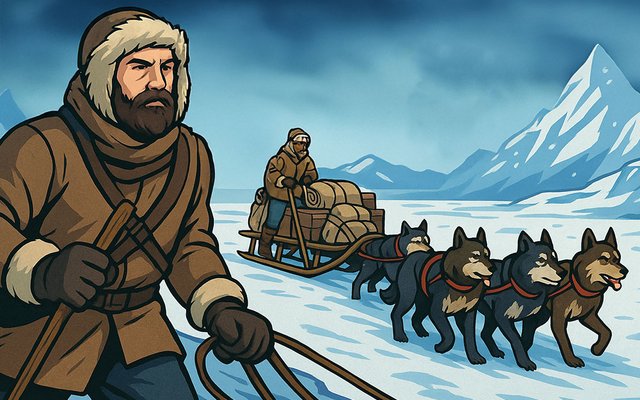
Read the text about the first explorers to go to the North Pole, then open the worksheet and solve the tasks.
At the start of the 20th century, the North Pole was one of the last places on Earth that no one had visited. Many explorers wanted to be the first to reach it. The journey was dangerous, but the reward — becoming world famous — was very attractive. Two explorers from the United States, Robert Peary and Frederick Cook, became very well-known because they both said they had reached the North Pole first. Their race to the North Pole became a story that was followed in newspapers all over the world.
The Arctic was not an easy place to travel through. Temperatures could fall to –40 °C, and snowstorms often started suddenly. Thick ice sometimes moved or broke, making travel difficult. In those days, there were no modern machines like planes or snowmobiles. Instead, explorers used dog sledges to carry food, tents, and other supplies. They also had maps, compasses, and help from the Inuit, the Indigenous people of the Arctic. The Inuit had a deep understanding of the land, snow, and weather.
In 1908, Frederick Cook began his long trip north. He took two Inuit men with him. After many weeks on the ice, he returned and said that he had arrived at the North Pole on 21st April 1908. At first, many people were excited. Newspapers called him the “Conqueror of the North Pole.” But when scientists checked his notes, they saw problems. The information was not clear, and he could not prove that he had been to the North Pole. Slowly, people began to wonder whether he had.
In 1909, Robert Peary began his own expedition. He had been working on a detailed plan for years. He built a larger team, collected more supplies, and wanted to travel faster than the Cook team. His team travelled in the extreme cold, and fought against the wind and ice during their journey. On 6 April 1909, Peary sent a message home saying that he had reached the North Pole. When he returned to the United States, he was welcomed as a national hero. Many believed that he had won the race.
But the story soon became more complicated. Other explorers and experts said that Peary’s team moved faster than anyone thought possible at that time. They began to question his story, too. Over the years, people have studied old notes, maps, and travel reports to find the truth. Even today, nobody knows for sure whether Cook or Peary have really stood at the exact North Pole.
The race between Cook and Peary was not just about reaching a place on the map. It was also about doing it for their country, becoming famous, and proving what humans can do in extreme conditions. It made people go on new polar expeditions and made the Arctic an important place in the history of exploration. Although their journey happened more than 100 years ago, people still remember it as one of the greatest races of the early modern age.